Transformers are widely used to adapt voltage levels, improve system compatibility, and enhance safety in electrical power systems. Among the most common transformer types are autotransformers and isolation transformers. While both perform voltage transformation, they differ significantly in construction, electrical behavior, safety characteristics, and suitable applications.
Selecting the wrong transformer type can lead to safety risks, grounding complications, protection issues, or unnecessary costs. This article explains the key differences between autotransformers and isolation transformers, outlines their advantages and limitations, and provides guidance on when each type is most appropriate.
What Is an Autotransformer?
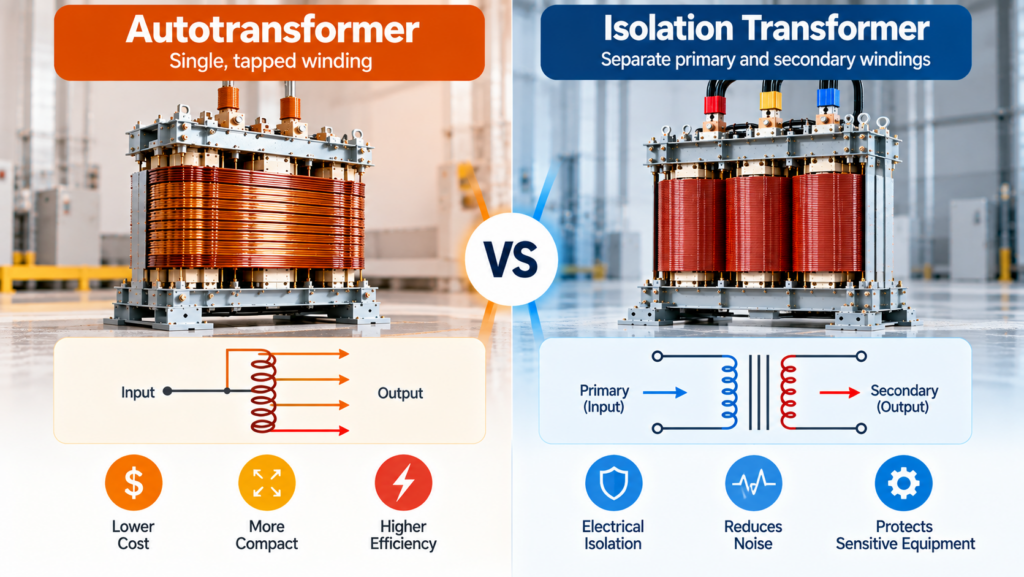
An autotransformer uses a single continuous winding that serves as both the primary and secondary. Part of the winding is common to both the input and output, with taps providing the desired voltage transformation.
Because energy is transferred both magnetically and electrically through the shared winding, autotransformers are smaller and more efficient than isolation transformers for the same kVA rating. However, this shared winding means there is no electrical isolation between the input and output circuits.
Autotransformers are typically used where the voltage change is modest, and isolation is not required.
What Is an Isolation Transformer?
An isolation transformer uses separate primary and secondary windings, with no direct electrical connection between them. Power is transferred purely through magnetic coupling via the core.
This separation provides galvanic isolation, meaning faults, transients, and ground potential differences on one side are not directly transferred to the other. Isolation transformers are widely used where safety, noise reduction, or grounding control is important.
Although they are generally larger and heavier than autotransformers, isolation transformers offer significantly greater protection and flexibility.
Key Differences in Construction and Operation
The most fundamental difference between autotransformers and isolation transformers lies in how their windings are arranged.
An autotransformer shares part of its winding between the input and output, which reduces material usage and losses. An isolation transformer keeps windings completely separate, increasing size and cost but improving safety and system control. Because of this difference, autotransformers transfer some power conductively, while isolation transformers transfer power only magnetically.
These construction differences drive the practical advantages and limitations of each design.
Autotransformer vs. Isolation Transformer: Key Differences

Advantages of Autotransformers

Autotransformers offer practical benefits when isolation is not required. Their reduced size and weight make them easier to install in space-constrained environments, and the lower material content results in lower cost. They also tend to be more efficient and exhibit lower impedance, which improves voltage regulation under load.
These characteristics make autotransformers attractive for applications where efficiency, size, and cost are key priorities.
Limitations of Autotransformers
The primary limitation of an autotransformer is the lack of electrical isolation. Faults, surges, or ground potential differences on one side can propagate directly to the other, reducing safety and limiting fault containment.
Autotransformers also offer limited grounding flexibility and typically result in higher available fault current, which can complicate protection coordination. As a result, they are generally unsuitable where isolation is required by code, safety standards, or application needs.
Advantages of Isolation Transformers
Isolation transformers provide full electrical separation between source and load. This improves personnel safety, reduces electrical noise, and allows designers to establish a new grounding reference on the secondary side.
They are particularly valuable in applications where fault containment, grounding control, or noise reduction is critical, such as sensitive electronic systems, industrial processes, and healthcare environments.
Limitations of Isolation Transformers
The main trade-offs associated with isolation transformers are size, weight, and cost. Because they require separate windings and additional insulation, isolation transformers are larger and heavier than autotransformers of the same kVA rating.
They also tend to have higher impedance, which can result in greater voltage drop under load. However, this impedance can be beneficial for limiting fault current and improving protection coordination.
Grounding and Safety Considerations
Grounding behavior is one of the most significant differences between autotransformers and isolation transformers. With an autotransformer, grounding on the primary side directly affects the secondary, limiting grounding options and increasing risk.
Isolation transformers allow the secondary system to be grounded independently, making them ideal for separately derived systems, controlled grounding schemes, and applications requiring enhanced safety and fault isolation.
Typical Applications
Autotransformers are commonly used where voltage adjustment is required without isolation, such as buck-boost applications, motor starting, and voltage matching between similar systems.
Isolation transformers are preferred where safety, noise reduction, or grounding flexibility is essential, including sensitive electronic loads, industrial systems, and installations governed by strict electrical code requirements.
Choosing the Right Transformer
The choice between an autotransformer and an isolation transformer should be driven by application requirements rather than cost alone. Where isolation, grounding control, or safety is critical, an isolation transformer is the correct choice. Where efficiency, size, and cost are priorities and isolation is not required, an autotransformer may be appropriate.
Conclusion
Autotransformers and isolation transformers serve distinct roles in modern power systems. Autotransformers provide compact, efficient, and cost-effective voltage transformation where isolation is not required. Isolation transformers deliver enhanced safety, grounding flexibility, and fault containment where electrical separation is essential.
Understanding the differences between these transformer types allows engineers to make informed decisions that improve safety, reliability, and system performance.