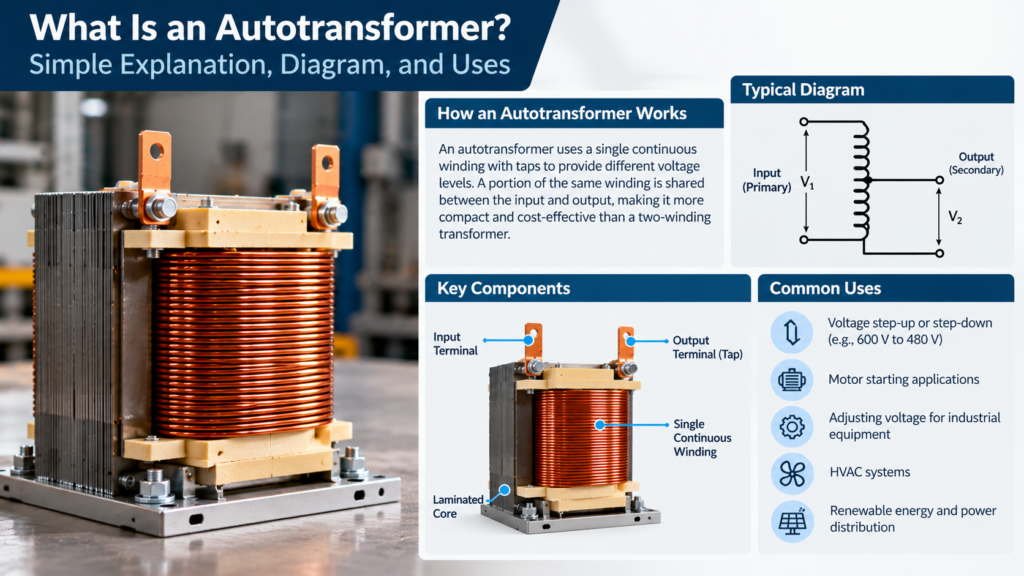
Autotransformers are widely used in electrical power systems, yet they are often misunderstood or confused with conventional isolation transformers. While both devices change voltage levels, an autotransformer does so using a simpler construction that offers advantages in size, efficiency, and cost—along with important limitations.
This article provides a straightforward explanation of what an autotransformer is, how it works, how it differs from an isolation transformer, and where it is most commonly used. A simple diagram is included to illustrate the basic concept.
What Is an Autotransformer?
An autotransformer is a transformer that uses a single continuous winding to perform voltage transformation. Unlike an isolation transformer, which has separate primary and secondary windings, an autotransformer shares part of the same winding between the input and output.
Voltage is changed by tapping the winding at different points. Depending on where the output is taken, the autotransformer can either step voltage up or step it down.
Because part of the winding is common to both sides, power is transferred both magnetically and electrically, which makes autotransformers more compact and efficient than isolation transformers.
How an Autotransformer Works
When voltage is applied to the full winding, a magnetic field is established in the core, just as in a conventional transformer. A portion of that winding is tapped to provide the desired output voltage.
Some of the power is transferred by transformer action (through the magnetic field), while the rest flows directly through the shared winding. This shared path is what reduces material requirements and losses—but it also means there is no electrical isolation between input and output.
Autotransformers can operate as:
- Step-down transformers, reducing voltage
- Step-up transformers, increasing voltage
- Buck-boost transformers, making small voltage corrections
- Simple Autotransformer Diagram (Conceptual)
Below is a simplified conceptual representation of an autotransformer winding:
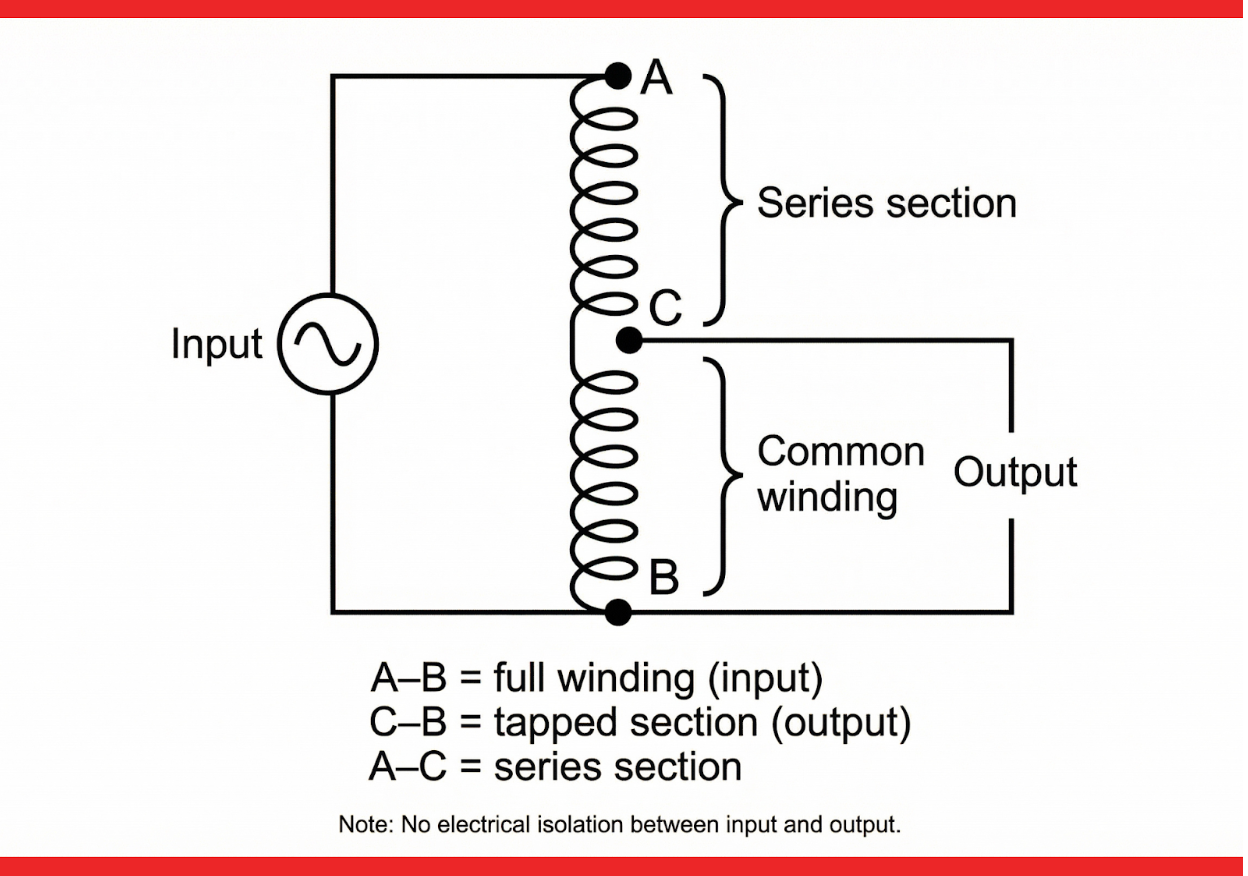
In this diagram:
- The full winding is connected to the input
- The output is taken from a tap on the same winding
- There is no physical separation between primary and secondary
This contrasts with isolation transformers, where primary and secondary windings are completely separate.
Key Differences Between Autotransformers and Isolation Transformers
The defining feature of an autotransformer is the lack of galvanic isolation. This has important implications for safety, grounding, and fault behavior.
Key distinctions include:
- Autotransformers share a winding; isolation transformers do not
- Autotransformers are smaller and lighter for the same kVA
- Autotransformers are typically more efficient
- Isolation transformers provide electrical separation and improved safety
Because of these differences, the two transformer types are not interchangeable.
Advantages of Autotransformers
Autotransformers offer several practical benefits when isolation is not required.
They are:
- Smaller and lighter, making installation easier
- More efficient, with lower losses
- Lower cost, due to reduced copper and core material
- Lower impedance, resulting in better voltage regulation
These advantages make autotransformers attractive for applications where voltage adjustment is needed without added complexity.
Limitations and Safety Considerations
The primary limitation of an autotransformer is that the input and output are electrically connected. This means:
- Faults on one side can propagate to the other
- Grounding conditions are shared
- There is reduced protection against electrical shock
- Higher fault currents may be present
Because of these factors, autotransformers are not suitable where isolation is required by electrical code, safety standards, or application requirements.
Typical Uses of Autotransformers
Autotransformers are commonly used in applications where voltage needs to be adjusted but isolation is unnecessary.
Common uses include:
- Buck-boost voltage correction (small voltage changes)
- Motor starting (reduced voltage starting)
- Voltage matching between similar systems (e.g., 600 V to 480 V)
- Industrial equipment with compatible grounding systems
- Laboratory or test setups where isolation is not required
They are especially popular when space and efficiency are priorities.
When Not to Use an Autotransformer
Autotransformers should generally be avoided when:
- Electrical isolation is required
- A separately derived system is needed
- Sensitive or critical loads are involved
- Grounding flexibility is important
- Safety considerations outweigh cost and size benefits
In these cases, an isolation transformer is the safer and more appropriate choice.
Autotransformers in Modern Power Systems
In modern electrical systems, autotransformers continue to play an important role, particularly in industrial and utility applications. When applied correctly, they provide a highly efficient and economical solution for voltage transformation.
However, proper understanding of their limitations is essential. Misapplication—especially where isolation is required—can lead to safety risks and system performance issues.
Conclusion
An autotransformer is a simple and efficient way to change voltage levels using a single winding. Its compact size, high efficiency, and lower cost make it an attractive option for many applications. However, the lack of electrical isolation means it must be applied carefully.
Understanding how autotransformers work—and when they should or should not be used—allows engineers and system designers to take advantage of their benefits while avoiding potential risks.