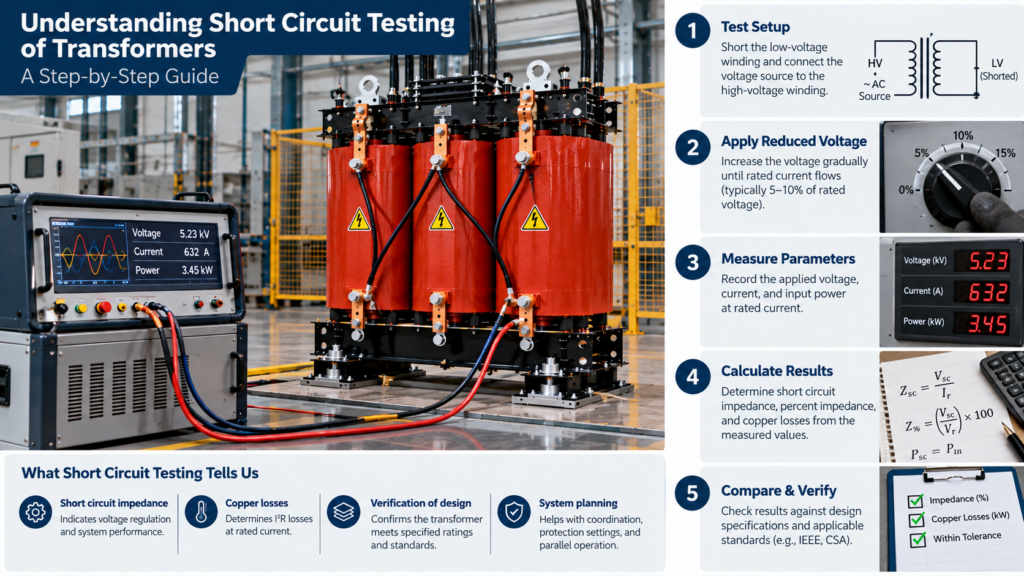
Short circuit testing is one of the most important validation steps in transformer design and manufacturing. While routine electrical tests confirm ratio, polarity, and losses, short circuit testing evaluates how the transformer behaves under the most mechanically and thermally stressful conditions it will ever experience.
For dry-type transformers, this is particularly critical. Unlike liquid-filled units, where oil provides additional mechanical damping and cooling, dry type designs rely heavily on solid insulation systems and mechanical bracing to withstand fault forces. Short circuit testing therefore provides direct evidence that the transformer can survive real-world fault events without structural or insulation failure.
This article explains what short circuit testing is, what it verifies, and how it is performed, with a focus on practical interpretation for engineers and specifiers.
What Is Short Circuit Testing?
Short circuit testing is performed to verify that a transformer can withstand the mechanical and thermal stresses associated with external short circuits.
During a fault, very high currents flow through the windings. These currents produce two primary stresses:
- Electromagnetic forces, which act on the windings and can cause deformation or displacement
- Thermal stress, caused by rapid heating due to high current flow over a short duration
The purpose of the test is not to simulate system protection behavior, but to confirm that the transformer’s internal construction—conductors, insulation, spacers, clamping structure—can endure these stresses without damage.
Standards such as IEEE C57.12.90 and IEC 60076-5 define the requirements and acceptance criteria for short circuit withstand capability.
Why Short Circuit Testing Matters in Practice
Short circuit events are relatively rare, but when they occur, they impose extreme conditions. A transformer that cannot withstand these stresses may experience:
- Winding deformation or displacement
- Insulation cracking or breakdown
- Changes in impedance or losses
- Progressive failure after the event
One of the more challenging aspects of short circuit damage is that it is not always immediately catastrophic. A transformer may remain energized but with internal mechanical damage that leads to premature failure months or years later.
For this reason, short circuit withstand capability is a key indicator of mechanical robustness, not just electrical performance.
Types of Short Circuit Tests
Short circuit testing is typically categorized into two complementary evaluations: thermal withstand and dynamic (mechanical) withstand.
Thermal Withstand Capability
This aspect evaluates whether the transformer can handle the heating effect of fault current over time, typically on the order of 1–2 seconds depending on system protection clearing time.
The focus is on:
- Conductor temperature rise
- Insulation thermal limits
- Hot-spot behavior
Thermal withstand is largely a function of conductor size, material properties, and cooling characteristics.
Dynamic (Mechanical) Withstand Capability
This is often the more demanding requirement. It evaluates the transformer’s ability to withstand instantaneous electromagnetic forces during the first cycles of a fault.
These forces are proportional to the square of the current and depend on winding geometry. They can cause:
- Axial compression or expansion
- Radial forces (hoop stress)
- Movement between winding layers
Mechanical withstand is heavily influenced by:
- Winding support structure
- Bracing and clamping design
- Resin system (for cast coil designs)
- Manufacturing quality and consistency
Both thermal and dynamic capabilities must be satisfied for a transformer to be considered short circuit robust.
Step-by-Step Overview of Short Circuit Testing
Short circuit testing is typically performed in specialized high-power laboratories due to the extreme currents required. The general procedure follows a structured sequence.
1. Pre-Test Measurements
Before applying any fault conditions, baseline measurements are taken. These typically include:
- Winding resistance
- Impedance voltage
- No-load and load losses
These values establish a reference point for post-test comparison.
2. Test Setup
The transformer is connected to a high-current source, often through a generator and impedance network capable of delivering controlled short circuit current.
One winding is energized while the other is short-circuited. The configuration is selected to produce the most severe stress condition based on the transformer design.
Instrumentation is installed to measure:
- Current magnitude and waveform
- Voltage
- Mechanical response (in some advanced setups)
3. Application of Short Circuit Current
A controlled short circuit current is applied for a specified duration. This duration is typically aligned with standard fault clearing times, often around 0.5 to 2 seconds depending on the test objective.
The applied current level is based on the transformer’s rated short circuit withstand capability, which is derived from its impedance and system assumptions.
During this period:
- Peak asymmetrical current produces maximum mechanical stress
- RMS current contributes to thermal stress
4. Post-Test Measurements
After the test, the same measurements taken before the test are repeated. The key objective is to detect any changes that would indicate internal damage.
Critical comparisons include:
- Changes in impedance (can indicate winding movement)
- Changes in losses (may indicate localized damage)
- Changes in resistance (possible conductor deformation or connection issues)
5. Inspection and Evaluation
Depending on the test protocol, additional inspection may be performed, including:
- Visual inspection (where accessible)
- Partial discharge testing
- Insulation resistance or dielectric testing
Acceptance criteria are defined by applicable standards. In general, the transformer must show no significant deviation from pre-test values and no evidence of mechanical or insulation failure.
Interpreting Test Results
For engineers and specifiers, the key question is not how the test is performed, but what its successful completion represents.
A transformer that passes short circuit testing has demonstrated:
- Mechanical integrity of the winding system
- Adequate bracing and clamping design
- Stability of electrical characteristics under stress
However, it is important to distinguish between:
- Type-tested designs, where a representative unit has been tested
- Routine-tested units, where each manufactured transformer is not individually subjected to short circuit testing
Most transformers are not short circuit tested on a per-unit basis due to the destructive potential and cost of the test. Instead, compliance is demonstrated through design qualification and similarity.
Design Factors That Influence Short Circuit Strength
Short circuit performance is not a single parameter—it is the result of multiple design decisions working together. Key influencing factors include:
- Winding geometry (disc vs layer, axial spacing)
- Conductor type and mechanical support
- Clamping structure and rigidity
- Insulation system (particularly in cast resin vs VPI designs)
- Manufacturing tolerances and consistency
For dry type transformers, cast resin designs often provide strong mechanical encapsulation, while VPI/VPE designs rely more heavily on bracing and structural support.
Common Misunderstandings
Several misconceptions often appear in specifications and discussions:
- Assuming impedance alone defines short circuit strength
- Treating short circuit withstand as purely a thermal rating
- Assuming all transformers of similar rating have equivalent mechanical robustness
- Overlooking the difference between tested design and tested unit
Short circuit performance is fundamentally a mechanical design problem under electrical excitation, not just an electrical rating.
Practical Specification Guidance
When short circuit performance is important—which is the case in most medium-voltage applications—engineers should consider:
- Requiring compliance with IEEE or IEC short circuit withstand standards
- Confirming whether the design has been type tested
- Evaluating mechanical construction approach, not just electrical ratings
- Coordinating transformer impedance with system fault levels
In critical applications, additional documentation or test evidence may be warranted.
Conclusion
Short circuit testing is one of the clearest indicators of a transformer’s mechanical and thermal robustness. It validates that the unit can survive the most severe electrical stresses it is likely to encounter in service.
For dry type transformers, where mechanical integrity of the winding system is essential, this testing provides confidence that the design is not only electrically correct, but structurally sound.
Understanding how short circuit testing works—and what it actually proves—allows engineers to make more informed specification decisions and avoid relying on incomplete or oversimplified indicators of performance.