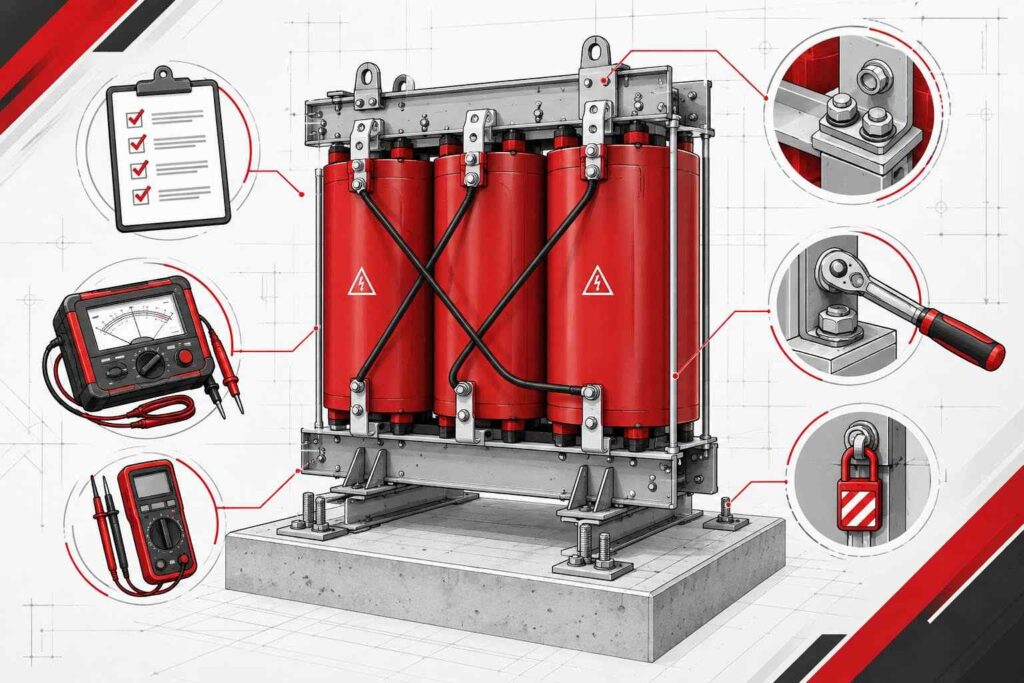
Transformer commissioning is the final engineering control point before a unit is placed into service. It verifies installation quality, system compatibility, and equipment condition under controlled conditions before the unit goes live.
For dry-type transformers, commissioning takes on added importance. Without a liquid dielectric system, performance depends directly on insulation condition, cleanliness, mechanical integrity, and airflow. Errors that pass through commissioning go straight into service as operational risks.
A structured approach is essential. ANSI/IEEE C57.94 should be treated as the primary reference framework for installation, application, operation, and maintenance of dry-type transformers.
While IEEE standards provide the overarching methodology, commissioning must also be carried out in accordance with the manufacturer’s installation, operation, and maintenance (IOM) manual. Manufacturer guidance defines design-specific limits — such as clearances, torque requirements, environmental constraints, and testing boundaries — that govern safe energization. Where differences exist, manufacturer requirements should take precedence for that specific unit.
Commissioning as a System-Level Verification
Commissioning is not limited to the transformer itself. It verifies alignment between:
- Transformer design and system conditions
- Installation quality and environmental constraints
- Protection settings and fault study assumptions
This system-level perspective is critical. Many commissioning issues arise not from transformer defects, but from mismatches between equipment and application.
Documentation and Configuration Verification
Before field inspection or testing begins, the transformer must be validated against the design intent. This includes confirming:
- Rated voltage and system voltage alignment
- Tap position relative to expected operating voltage
- Vector group compatibility with system configuration
- Impedance consistency with protection coordination studies
Tap position deserves particular attention. Transformers are often shipped at nominal tap, but site voltage conditions may require adjustment. Incorrect taps can result in sustained overvoltage or undervoltage conditions that are not immediately obvious during energization.
Mechanical and Installation Verification
Mechanical condition directly influences dielectric performance and thermal behavior.
Commissioning should confirm that the installation supports both electrical integrity and cooling performance. This involves verifying:
- Adequate clearance for airflow and maintenance access
- Proper mounting, including use of anti-vibration isolation where required
- Removal of shipping restraints after final positioning
- Absence of debris, dust, or foreign objects inside the enclosure
Connection integrity is equally important. Bus and cable terminations must be:
- Clean and properly aligned
- Free of mechanical strain
- Tightened to specified torque values in accordance with the manufacturer’s IOM manual
Loose or misaligned connections are a primary source of localized heating and long-term insulation degradation.
Environmental and Pre-Energization Condition
Dry-type transformers are sensitive to environmental conditions at the time of energization. Commissioning should verify that:
- The installation environment is clean and dry
- Ventilation openings are unobstructed
- No condensation is present on windings or insulation surfaces
- Room ventilation or HVAC capacity is sufficient for heat removal
If the transformer has been stored or exposed to humidity, insulation condition must be verified prior to energization. Moisture is one of the most significant risk factors for dielectric failure in dry-type units. If insulation resistance is below acceptable levels or moisture is suspected, controlled drying procedures should be completed before proceeding.
Storage duration is itself a risk factor. A transformer delivered last week and a transformer that has been sitting at a job site for six months represent very different commissioning cases. For units with extended storage, insulation resistance should be measured and trended over time before energization, not just spot-checked at commissioning.
Cold weather introduces additional constraints. Where applicable, controlled warm-up procedures should be followed to prevent differential thermal expansion between conductors and insulation systems.
Electrical Testing
Field testing provides objective confirmation that the transformer is suitable for service and establishes a baseline for future condition assessment. Testing should align with IEEE guidance and manufacturer limits.
- Insulation Resistance (Megger): Confirms insulation integrity and dryness. Insulation resistance on the order of 2 MΩ per kV of rated voltage is commonly used as a reference for dry-type units under typical conditions. Measurements should be temperature-corrected to the manufacturer’s reference temperature (typically 20°C) and recorded for future trending.
- Winding Resistance: Identifies high-resistance joints, loose connections, or internal damage. Phase-to-phase consistency is key.
- Turns Ratio (TTR): Verifies transformation ratio and confirms correct tap settings.
- Polarity and Phase Relationship: Confirms proper phase rotation and compatibility with system connections or parallel operation.
- Applied Voltage (Hipot), where specified: Performed in accordance with IEEE guidance and limited to manufacturer-recommended levels to avoid overstressing insulation.
- Partial Discharge (PD), where specified: Particularly for cast coil and VPI/VPE units, field PD testing during commissioning establishes a baseline against the factory PD result and verifies that installation conditions — cable routing, clearances, terminations — have not introduced new discharge sources. See our article on Partial Discharge in Dry-Type Transformers for a fuller treatment.
Testing should be performed in a controlled and repeatable manner, with environmental conditions recorded to support future trending.
Auxiliary Systems and Functional Verification
Auxiliary systems must be fully operational prior to energization. Temperature monitoring systems should be verified for:
- Correct sensor placement
- Accurate signal transmission
- Proper alarm and trip setpoints
Where forced-air cooling is provided, fan operation and control logic must be confirmed. These systems are typically staged based on winding temperature and are critical for maintaining thermal limits under elevated loading.
Protection System Alignment
Transformer protection must be validated as part of commissioning, not assumed correct. This includes confirming:
- Relay settings align with coordination studies
- Trip functions operate correctly under simulated conditions
- Alarm and monitoring signals are correctly integrated
Improper protection configuration can result in either failure to trip under fault conditions or nuisance tripping during normal operation, including energization.
Pre-Energization Readiness
Prior to energization, the transformer must be in a verified, controlled state. This condition includes:
- All inspections and tests completed and reviewed
- Electrical connections confirmed and properly torqued
- Grounding system in place and verified
- Tap settings confirmed
- Enclosure secured with all panels in place
- No foreign material inside the unit
This stage represents the final opportunity to identify issues before exposure to system voltage.
Energization and Initial Operation
Energization should be performed from the source side with downstream load minimized where practical.
Transformer inrush current is expected and may reach several multiples of rated current. Protection systems must be configured to tolerate this transient condition.
During initial operation, attention should be given to:
- Acoustic behavior (abnormal noise or vibration)
- Electrical balance (voltage and current)
- Thermal response
- Any signs of insulation distress
Initial operation is not a passive step — it is part of commissioning and should be actively observed.
Documentation and Handover
Commissioning produces records that become the operational baseline for the transformer’s entire service life. The handover package should include:
- Signed and dated test reports for every test performed
- Configuration records (tap position, protection settings, sensor calibrations)
- Photographs of the nameplate, internal condition, and terminations
- A punch list of any deviations or items to be addressed post-commissioning
- The manufacturer’s IOM manual, kept on file for future reference
These documents are not paperwork. They are the reference baseline against which future testing, troubleshooting, and condition assessment will be performed. Without them, every future inspection is starting from scratch.
Who Performs Commissioning
Commissioning responsibility varies by project. For utility-scale and critical installations, NETA-certified field testing is often required by specification. For commercial and light-industrial installations, the installing contractor or a third-party testing agency typically performs commissioning. Manufacturer support — including factory test reports, IOM documentation, and direct engineering involvement — is available on most projects and can be especially valuable for unfamiliar designs or critical applications.
Common Commissioning Issues
Field experience shows that commissioning deficiencies are typically procedural rather than design-related. Common issues include:
- Incorrect tap configuration
- Loose or improperly torqued connections
- Contamination from construction debris
- Inadequate ventilation clearance
- Moisture ingress prior to energization
- Misaligned protection settings
These issues often do not cause immediate failure but create conditions for accelerated aging or intermittent operational problems.
Lifecycle Implications
Commissioning establishes the initial condition of the transformer’s insulation system, connections, and thermal environment. Deficiencies at this stage can lead to:
- Partial discharge due to contamination or moisture
- Thermal hotspots at high-resistance joints
- Reduced insulation life expectancy
- Increased maintenance requirements and reduced reliability
The cost of these consequences compounds over time. A loose connection caught at commissioning is a five-minute torque check. The same loose connection caught five years later, after thermal cycling has degraded the surrounding insulation, can be a winding replacement or a full unit failure. A properly commissioned transformer, by contrast, operates within its intended thermal and dielectric limits, supporting predictable long-term performance over a 25–30 year service life.
Conclusion
Transformer commissioning is a structured engineering process that validates installation, confirms system compatibility, and establishes a reliable baseline for operation.
For dry-type transformers, the absence of liquid insulation places greater emphasis on cleanliness, environmental control, and connection integrity. Following a disciplined approach aligned with ANSI/IEEE C57.94 — and grounded in manufacturer-specific IOM requirements — ensures that the transformer enters service under the correct conditions.
Commissioning is not simply about energizing equipment. It defines how that equipment will perform over its entire service life.
Rex Power Magnetics provides commissioning support for our dry-type transformers, including factory test reports, IOM documentation, and direct engineering involvement during field commissioning. Contact our engineering team for unit-specific commissioning guidance.