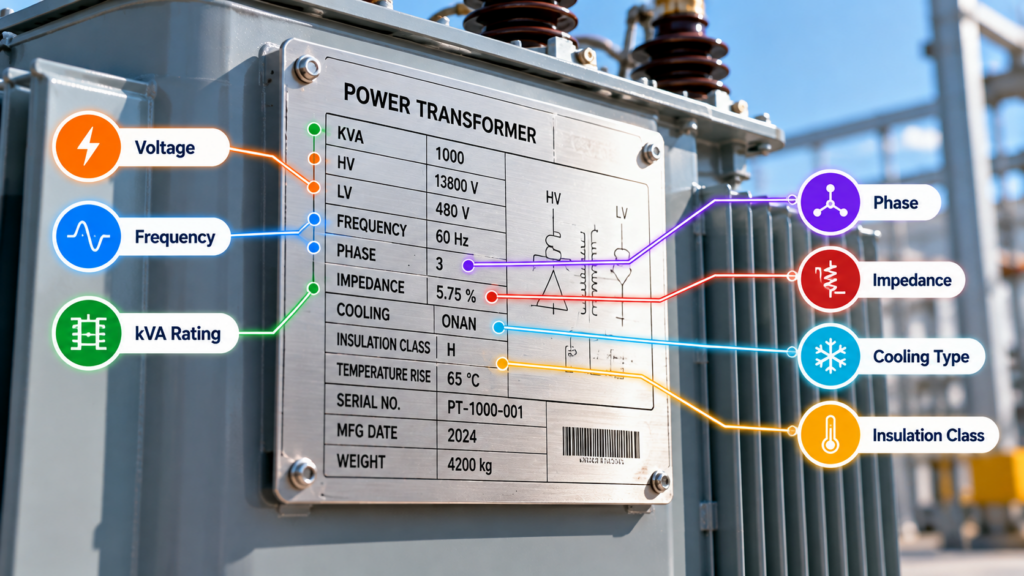
Transformer nameplates are often treated as simple identification labels—useful for confirming voltage or kVA during installation. In practice, they are compact engineering specifications. Each value on the nameplate defines a boundary condition for how the transformer will perform electrically, thermally, and mechanically.
For dry-type transformers, this is particularly important. Their performance is closely tied to ambient conditions, enclosure selection, cooling method, and load characteristics. Interpreting the nameplate correctly is therefore not just a commissioning task, it is part of proper system design and specification.
Rated Power: Interpreting kVA in Context
The kVA rating defines the apparent power the transformer can deliver continuously under its rated conditions. Those conditions include rated voltage and frequency, standard ambient temperature, and adequate cooling.
In practice, those assumptions are not always met. Several factors commonly reduce usable capacity:
- Harmonic-producing loads (VFDs, UPS systems, rectifiers) increase internal heating
- Elevated ambient temperature reduces thermal margin
- High altitude reduces cooling effectiveness
- Enclosure restrictions limit airflow
As a result, the nameplate kVA should be interpreted as a thermal rating under defined conditions, not a guaranteed capacity under all operating scenarios.
Voltage Ratings and Tap Adjustments
Primary and secondary voltages establish how the transformer interfaces with the system. A typical nameplate might indicate 13.8 kV primary and 480Y/277 V secondary. These values also correspond to insulation design and operating limits.
Most dry type transformers include off-load taps to adjust the effective turns ratio. These are typically provided in small increments (e.g., ±2 × 2.5%) to compensate for supply variation.
In application, tap settings are often underappreciated. They should be selected based on expected system conditions, not left as a field correction. Persistent voltage issues are frequently traced back to incorrect tap positioning rather than upstream supply problems.
Frequency: A Core Design Constraint
Transformer cores are designed for a specific frequency, most commonly 60 Hz or 50 Hz. The relationship between voltage and frequency determines magnetic flux density in the core. If frequency decreases while voltage remains constant, flux increases and can push the core toward saturation.
This is why a 60 Hz transformer cannot be applied at 50 Hz at full voltage without review. Either voltage must be reduced, or the transformer must be derated. Frequency is therefore not just a nominal value—it is a fundamental design parameter.
Impedance: Fault Levels and Voltage Behavior
Transformer impedance is often discussed in terms of fault current, but its role is broader than that. It influences both short-circuit performance and voltage behavior under load.
From a fault perspective, higher impedance reduces available short-circuit current. This can ease equipment duty and support protection coordination.
From a voltage perspective, the situation is more nuanced. Voltage regulation depends on both the transformer impedance and the load power factor. A simplified relationship is:
%VR≈I⋅(Rcosϕ+Xsinϕ)
Because transformer impedance is predominantly reactive:
- At or near unity power factor, voltage drop is driven mainly by resistance and is typically modest
- At lagging power factor, the reactive component dominates and voltage drop increases
- At leading power factor, voltage rise can occur
This leads to an important clarification: higher impedance does not inherently mean poor voltage regulation. However, in most real installations—where loads are inductive—it does result in greater voltage drop.
In practice, impedance selection is a trade-off between:
- Fault current limitation
- Voltage performance under expected load conditions
- Temperature Rise and Insulation System
Temperature rise and insulation class are closely related but serve different purposes. Temperature rise defines how much hotter the winding operates above ambient at rated load, while insulation class defines the maximum temperature the insulation system can withstand.
For example, a transformer with a 150°C rise and 220°C insulation class includes thermal margin between operating conditions and material limits.
This has direct lifecycle implications. Lower temperature rise designs operate cooler and generally provide longer insulation life, while higher temperature rise designs are more compact and cost-effective but operate with less thermal margin. The selection is ultimately a balance between first cost and long-term reliability.
Cooling Class and Operational Dependence
Cooling class defines how heat is removed from the transformer. Air natural (AN) units rely on passive cooling, while air forced (AF) units use fans to increase capacity.
Where both are provided, the nameplate may show dual ratings—for example, a base AN rating and a higher AF rating. This introduces an operational consideration: the higher rating depends on active cooling systems.
In facilities where the AF rating is used continuously, fan performance becomes a reliability dependency. Loss of forced cooling is not just a minor issue—it may require immediate load reduction.
Winding Configuration and System Interaction
The winding configuration—delta, wye, or grounded wye—determines how the transformer interacts with the system.
This affects several behaviors simultaneously:
- Grounding method and system reference
- Fault current paths and protection response
- Harmonic performance, particularly triplen harmonics
For example, a delta winding can trap triplen harmonics, while a grounded wye provides a stable reference for system grounding. These are system-level considerations that extend beyond simple connection diagrams.
Basic Insulation Level (BIL)
BIL defines the transformer’s ability to withstand transient overvoltages such as lightning or switching surges. It is not related to continuous operating voltage but to impulse survivability.
This becomes particularly relevant in:
- Utility-connected systems
- Outdoor installations
- Locations with higher lightning exposure
BIL should be coordinated with system insulation levels and surge protection strategy to ensure consistent protection across equipment.
Enclosure Type and Thermal Impact
Enclosure selection is often driven by environmental requirements, but it also affects thermal performance. Ventilated enclosures allow better heat dissipation, while more protective enclosures can restrict airflow.
This creates a trade-off between:
- Environmental protection (moisture, dust, corrosion)
- Cooling effectiveness and thermal margin
As a result, enclosure type should be evaluated alongside loading and ambient conditions, not treated as a purely mechanical decision.
Standards and Compliance
Nameplates typically reference applicable standards such as IEEE, NEMA, CSA, or DOE efficiency requirements. These define the basis for testing, performance expectations, and regulatory compliance.
Verification of these standards during specification is important, particularly where jurisdictional requirements or efficiency mandates apply.
Identification and Traceability
Serial number and manufacturer information provide traceability to factory records, test data, and support documentation. Given the long service life of transformers, this information becomes increasingly important over time for maintenance and asset management.
Putting the Nameplate into Practice
Most issues related to transformer nameplates arise not from missing information, but from incomplete interpretation. Individual values are often read correctly but not considered together.
Typical examples include:
- Assuming kVA applies regardless of harmonic content or ambient conditions
- Evaluating impedance without considering load power factor
- Overlooking the operational implications of cooling method
- Treating tap settings as adjustments rather than design inputs
A transformer nameplate should be read as a coordinated set of constraints, not a list of independent values.
Conclusion
A transformer nameplate is a concise engineering specification that defines how the unit is intended to perform. For dry type transformers, its proper interpretation requires understanding how electrical, thermal, and environmental factors interact.
Used correctly, nameplate data supports better specification decisions, improved system performance, and more predictable long-term operation. Misinterpreted, it can lead to avoidable issues that only become visible after energization.
The difference lies not in the data itself, but in how it is applied.